
How Do You Verify Custom Part Fitment?
Last Updated: October 26, 2026
Quick Summary
To verify custom part fitment, decode your vehicle’s VIN to confirm year, make, model, and variant, match OEM part numbers to your vehicle specs, and measure the actual surface where the part will install. Get written confirmation from the seller before you buy.
- Use your 17-character VIN with the retailer’s decoder tool to reveal your vehicle’s exact configuration including engine type and trim level
- Match OEM part numbers between your vehicle specification and the product listing exactly before purchasing
- Measure the length, width, depth, and curvature of the surface the part will cover, not just the factory specification sheet
- Confirm production date restrictions and vehicle variants like coupe versus convertible, as these affect fitment compatibility
- Save screenshots, measurements, and written fitment confirmation from the seller with your order for protection if the part does not fit
Table of Contents
- Why Verifying Custom Part Fitment Matters
- Using VIN Lookup for Auto Parts
- Matching OEM Part Numbers and Component Codes
- Confirming Year, Make, Model, and Vehicle Variant
- Creating Your Car Part Fitment Checklist
- Questions to Ask Before Buying Custom Car Parts
- Verifying Custom Corvette Accessories Fitment
- Place Your Custom Part Order with Confidence
- Frequently Asked Questions
Why Verifying Custom Part Fitment Matters
Getting the wrong part is expensive: you’re stuck with a return, a refund delay, or a part that’s stuck on your car. When you’re building a custom look for your Corvette, verify custom part fitment before you buy to save time, money, and frustration.
A simple verification process can help identify a mismatch with your vehicle’s configuration before you buy.
Fitment mistakes cost you in three ways:
- Time wasted on returns and replacements
- Money lost on shipping and restocking fees
- Delays to your build timeline, especially if you’re prepping for a car show
This guide walks you through how to verify custom part fitment step by step, so you know exactly what to check before ordering.
Using VIN Lookup for Auto Parts
Your Vehicle Identification Number is the master key to fitment verification. A VIN decode reveals year, make, model, engine type, transmission, trim level, and production date, details that narrow down which parts will actually fit your specific vehicle.
Here’s how to use your VIN for fitment:
- Locate your VIN on your driver’s side door jamb or dashboard
- Copy the full 17-character code
- Enter it into a VIN decoder tool on the parts retailer’s website
- Review the decoded vehicle information carefully
- Cross-check the details against the part’s fitment requirements
Always verify that decoded data matches your actual vehicle and contact the retailer if something looks wrong.
Matching OEM Part Numbers and Component Codes
OEM part numbers are your second line of defense, identifying the exact component your vehicle needs. Each number corresponds to a specific part designed for specific vehicles, so matching numbers confirms compatibility at the component level.
Steps to match OEM numbers:
- Find your vehicle’s OEM part number in your owner’s manual or parts catalog
- Locate the OEM number on the product listing for the custom part
- Compare them directly, they should match exactly
- If they differ, ask the seller why before purchasing
- Document both numbers for your records
Confirming Year, Make, Model, and Vehicle Variant
Year, make, and model form the foundation of fitment verification, but variants matter just as much. Your C8 Corvette might be a coupe or convertible, and these variants change which parts fit, a part designed for a coupe won’t work on a convertible, even in the same year and model.
Verify these details on every custom part:
- Year: Exact year of manufacture (2023, 2024, 2025, etc.)
- Make: Chevrolet, GMC, Cadillac, Ford, or other manufacturer
- Model: Corvette, Sierra, Escalade, Mustang, etc.
- Variant: Coupe/convertible, bed length, trim level, engine type
- Production date range: Some parts fit only vehicles built within specific date ranges
Check the product description carefully. When in doubt, contact the seller with your specific vehicle details.
Creating Your Car Part Fitment Checklist
Before you click buy, run through this checklist. It takes five minutes and prevents costly mistakes.
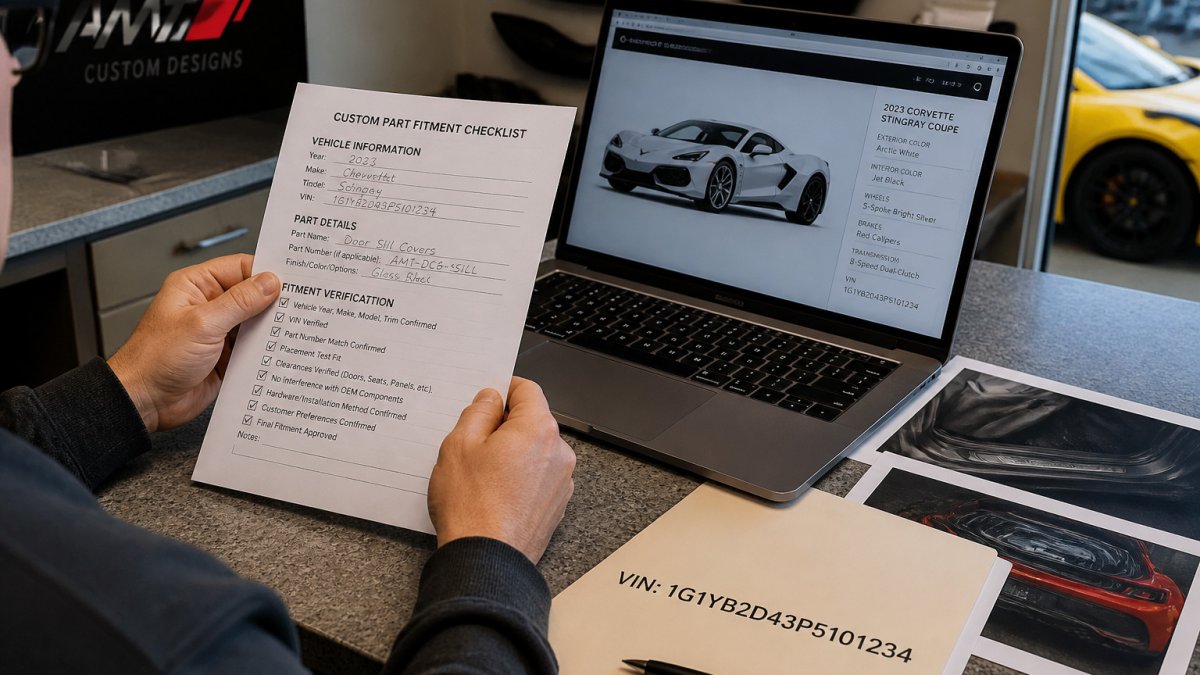
Your pre-purchase fitment checklist:
- I have my complete VIN and decoded it using the retailer’s tool
- The product listing confirms my year, make, and model
- The product confirms my vehicle variant (coupe/convertible, trim level, options)
- OEM or component numbers match my vehicle’s specs
- I’ve checked for any production date restrictions
- The product images show fitment on a vehicle like mine
- I’ve verified the part mounts on top of existing components (not as a replacement requiring removal)
- The seller’s fitment description matches my vehicle configuration
- I have written confirmation of fitment from the retailer
- I understand the return policy if fitment is wrong
Save this checklist to your phone and go through every item before ordering.
Add the measurement pass for overlay and custom parts
Catalog checks confirm a part is listed for your vehicle, not that it will sit correctly on the surface it covers. For parts that install on top of factory components, door sill covers and trunk upper and lower covers, add a physical measurement pass to the checklist above.
What to measure before you order:
- The covered surface, not the whole panel. Measure the length and width of the factory area the part will sit on, plus the depth of any recess or lip the part must clear.
- Curvature and contour. Most interior and body surfaces are not flat. Note where the surface bends, steps down, or meets a seal. A flat overlay will bridge a curve and lift at the edges; a part designed for that contour will follow it.
- Clearance to moving parts. Check door swing, trunk lid travel, seat movement, and any hinge or latch path. An overlay that adds even a small amount of thickness can contact a seal or trim piece when the door or lid closes.
- Fastener and adhesive locations. Identify where the factory surface has clips, screws, or seams. The custom part’s mounting points need to land on solid material, not on a seam or a hollow.
- Tolerance stack-up. Factory panels vary slightly from car to car. A common pattern is for installers to allow a small margin, roughly the thickness of the trim or seal being covered, so the part seats without forcing. Ask the seller what tolerance their part is designed to, and compare it to your measurements.
Pro Tip
Measure twice with the same tape or caliper, and photograph the tape against the surface. Those photos become your evidence if a part arrives and does not match the listing.
Measure twice with the same tape or caliper, and photograph the tape against the surface. Those photos become your evidence if a part arrives and does not match the listing.
A repeatable workflow for modified and custom vehicles
Once a car has been modified, different wheels, suspension changes, added trim, or a custom interior, use this order:
- Start with the VIN to establish the factory baseline.
- List every modification that touches the area the part covers or mounts to.
- Measure the as-built surface rather than trusting the factory spec.
- Ask the seller to confirm against your measurements, not just your VIN.
- Get the confirmation in writing before you pay.
Resolve conflicts before you buy
When the catalog, the VIN decode, and the seller disagree, ask the seller to explain the discrepancy in writing.
Keep the evidence
Save the following with your order confirmation:
- Screenshots of the product listing and fitment notes
- Your VIN decode output
- Photos of your measurements against the surface
- The seller’s written fitment confirmation
- The return and exchange terms as they appeared at purchase
Work through these verification steps before placing your order to catch fitment issues early.
| Verification Step | What to Check | Why It Matters |
|---|---|---|
| VIN Decode | Year, make, model, engine, transmission, trim level | Confirms your vehicle’s exact factory configuration |
| OEM Part Numbers | Match numbers between your vehicle spec and product listing | Ensures component-level compatibility |
| Vehicle Variant | Coupe vs. convertible, trim level, options | Same year and model can have different fitment |
| Production Date Range | Factory build date against part restrictions | Some parts fit only vehicles built in specific windows |
| Physical Measurements | Length, width, depth, curvature of covered surface | Overlay parts must match actual surface, not spec sheet |
| Clearance Check | Door swing, trunk travel, seat movement, hinges | Added thickness can contact seals or trim when closing |
| Fastener Locations | Clips, screws, seams on factory surface | Mounting points must land on solid material |
| Written Confirmation | Seller’s fitment verification against your VIN and measurements | Protects you if part arrives and does not match listing |
Questions to Ask Before Buying Custom Car Parts
Essential questions:
- “Does this part fit a [your year] [your make] [your model] [your variant]?”
- “What is the OEM part number this part replaces or matches?”
- “Are there any production date restrictions for my vehicle?”
- “Can you confirm fitment using my VIN?”
- “What happens if the part doesn’t fit my vehicle?”
- “How long is your return window, and who pays for return shipping?”
- “Do you have photos of this part installed on a vehicle like mine?”
Verifying Custom Corvette Accessories Fitment
Engine bay components, interior trim, and exterior accessories all need careful verification, and the checks differ by part category.
C8-specific fitment considerations:
- Engine bay components vary between coupe and convertible models
- Interior trim pieces differ based on trim level and options
- Exterior accessories must clear the Corvette’s distinctive body lines
- Production changes throughout the model year affect component compatibility
- Custom graphics and finishes require accurate part dimensions
When verifying C8 fitment, always confirm the specific model year and variant.
Verify by part category
Generic vehicle-level checks are not enough for custom accessories. Run the check that matches the part you are buying.
Door sill covers and interior overlays. These install on top of the factory sill.
Trunk upper and lower covers.
Door props and similar hardware.
Custom graphics and finishes. Custom graphics can make parts unique.
Measure the surface, not the spec sheet
For overlay-style parts, the factory spec sheet tells you what the car was designed to be, not what is on your car now. Measure the actual surface the part will cover, length, width, depth of any recess, and the location of seams, clips, and seals, photograph the tape against it, and ask the seller to confirm against your numbers.
Watch Out
Ask for confirmation against your specific VIN and your measurements.
Ask for confirmation against your specific VIN and your measurements.
Confirm before production
AMT Custom Designs specializes in C8 Corvette accessories. Our door sill covers and trunk upper and lower covers install on top of factory components.
Place Your Custom Part Order with Confidence
You’ve verified fitment. You’ve asked the right questions. Now it’s time to order.
Document everything before you buy. Browse and purchase custom parts from our shop after you’ve verified fitment against your VIN and measurements. Save screenshots of the product listing, the fitment confirmation, and the OEM numbers. Keep the seller’s written fitment verification.
Order from retailers who take fitment seriously, clear fitment information, quick answers, and products they stand behind. The difference between a successful build and a frustrating one comes down to verification. Your car show-ready Corvette will thank you.
Frequently Asked Questions
How do I verify that a custom part will fit my car using my VIN?
Decode your VIN using the 17-character sequence. Enter the decoded information into the seller’s fitment tool or cross-reference it against the OEM part number listed in the product description.
What vehicle details do I need to check before ordering custom car parts?
Gather your vehicle’s year, make, model, trim level, engine size, and body style. For custom accessories like door sill covers or engine bay components, note any existing modifications or non-standard features. Having these details ready helps you cross-check fitment information with the seller.
What should I ask a seller before buying custom car parts?
Ask the seller to confirm your vehicle’s year, make, model, and trim. Ask if the part installs on top of factory components.
Are aftermarket and custom parts guaranteed to fit my vehicle?
Not all aftermarket and custom parts fit every vehicle without verification. Check the vehicle configuration and the product information before purchasing.
Fitment verification isn’t complicated, but it’s essential. Rushing this step costs time and money. By following this process, you avoid returns, delays, and the disappointment of parts that don’t fit. AMT Custom Designs builds custom accessories designed for specific vehicles. Our team verifies fitment for your exact configuration, ensuring every part arrives ready to install. Get started with AMT Custom Designs and build your custom look with confidence.
