
Carbon Fiber vs Hydro Dipped Car Parts: C8 Guide
Table of Contents
- Carbon Fiber vs Hydro Dipped Car Parts: The C8 Owner’s Comparison
- What Is Hydro Dipping on Car Parts?
- Real Carbon Fiber: Weave, Depth, and What It Actually Delivers
- Hydro Dipped Car Parts Durability: What Holds Up Over Time
- How to Clean Hydro Dipped Car Parts Without Dulling the Finish
- C8 Corvette Engine Bay Accessories: Where Each Finish Shines
- Conclusion: Which Finish Fits Your Build?
- Frequently Asked Questions
Last Updated: October 15, 2026
Carbon Fiber vs Hydro Dipped Car Parts: The C8 Owner’s Comparison
Choosing between carbon fiber vs hydro dipped car parts comes down to one question: do you want the real material, or the real look?
Here is the honest answer up front. Real carbon fiber is a structural composite.
That distinction matters more than most buyers expect. Below, we break down appearance, durability, maintenance, and where each finish makes sense on a C8.
overview of water transfer printing from the American Composites Manufacturers Association
Quick Comparison: Real Carbon Fiber vs Hydro Dipped Finishes
| Factor | Real Carbon Fiber | Hydro Dipped Carbon Pattern |
|---|---|---|
| What it is | Woven carbon strands set in resin | Printed film transferred onto a base-coated part |
| Appearance | Visible weave with true depth | Carbon-fiber pattern with strong gloss |
| Weight savings | Yes, lighter than many metals | None; the base part is unchanged |
| Structural benefit | Yes, high strength-to-weight | No; cosmetic only |
| Cost | Typically the highest option | Generally the lower-cost route |
| Repair | Specialist repair, often difficult | Can often be re-dipped or refinished |
| Best for | Structural and high-end aesthetic builds | Engine bay, interior, and show detail work |
What Is Hydro Dipping on Car Parts?
Hydro dipping on car parts is a finishing process that floats a printed film on water and transfers it onto a prepared, base-coated surface.
Water transfer printing is the formal name for the same process. A hydrographic film carries the pattern. An activator turns that film into a floating layer.
The important part for buyers: hydro dipping changes how a part looks, not what it is made of.
How the Water Transfer Printing Process Works
The sequence is short but unforgiving. Surface preparation comes first, because any contamination shows through the finish. A base coat goes down next, and its color shapes the final tone of the pattern.
Then comes film placement across the water, followed by activation and the dip itself.
A clear coat seals everything. That top layer controls the high-gloss finish and does most of the work protecting the pattern underneath.
Pro Tip
Ask any finisher how they handle complex curves before you commit. A shop that talks about controlled film stretching and pattern alignment is usually a shop that has already ruined a few parts learning the lesson.
Ask any finisher how they handle complex curves before you commit. A shop that talks about controlled film stretching and pattern alignment is usually a shop that has already ruined a few parts learning the lesson.
Real Carbon Fiber: Weave, Depth, and What It Actually Delivers
Genuine carbon fiber is a composite: carbon strands woven into cloth, then set in resin.
That construction brings two things a finish cannot copy. The first is weight.
Where it falls short is practical. Real carbon fiber parts usually cost the most of any option here, and damage is rarely a simple fix.
For a C8 owner chasing authenticity above all else, nothing else substitutes. For an engine bay build, that authenticity may not be worth the premium.
Hydro Dipped Car Parts Durability: What Holds Up Over Time
Hydro dipped car parts durability depends on three layers working together: the base coat under the film, the printed pattern itself, and the clear coat on top. The pattern is only microns thick. The clear coat is the armor, and the base coat is the foundation that keeps the film from telegraphing surface flaws.
That is why two dipped parts made from the same film can age very differently. The film is rarely the failure point. The coating system is.
How Each Layer Fails
- Base coat failure shows as blotchy color or a pattern that looks washed out in spots. It usually traces back to surface preparation, oils, mold release, or sanding dust left under the coating.
- Pattern failure shows as lifting, peeling, or bubbling at edges and tight radii. This is almost always a film-stretch or activation problem, not a wear problem.
- Clear coat failure shows as dulling, hazing, or fine scratches that hold light. This is the layer you actually touch, clean, and expose to the sun.
Most practitioners find that a properly cleared dipped part handles an engine bay environment well. The conditions there are real but bounded: heat cycling as the bay warms and cools, fuel and oil vapors, and occasional wipe-downs. A part with a thin or uneven clear coat will dull or lift at the edges long before a properly coated one does.
Environment by Environment
- Engine bay: Heat cycling and fumes are the main stressors. A quality clear coat handles both. Watch the edges of covers and trim where film stretched the most.
- Interior: High-touch areas like door sills and grab handles wear from skin oils and abrasion, not UV. A satin or matte clear holds up better cosmetically than a high-gloss one in these spots.
- Exterior: UV is the real test. Exterior parts face sun exposure that interior and engine bay parts never see, and UV is what breaks down a clear coat over time. That is why an engine cover and a roof panel are not the same assignment.
What Actually Shortens the Life of a Dipped Finish
- Abrasive polishes and stiff-bristle brushes, which cut through the clear coat
- Solvent-based dressings and harsh chemicals, which can cloud the top layer
- Pressure washing at close range, which can lift film at edges
Watch Out
Never hit a dipped part with an abrasive polish or a stiff-bristle brush. You will cut through the clear coat and expose the printed pattern underneath, and that damage cannot be polished back out.
Never hit a dipped part with an abrasive polish or a stiff-bristle brush. You will cut through the clear coat and expose the printed pattern underneath, and that damage cannot be polished back out.
Repair, Removal, and Refinishing
This is where a dipped finish has a real advantage over genuine carbon fiber. A chipped or dulled dipped part can often be scuffed and re-cleared, or stripped and re-dipped entirely, restoring the original look.
Removal is also straightforward. A dipped finish can be stripped back to the base part with the right process, which means a part you customize today is not locked into that look forever.
Key Takeaway
Judge a dipped part by its coating system, not its pattern. Ask how many coats of clear went on, what type of clear it is, and how the edges were sealed. Those answers predict longevity better than any photo.
Judge a dipped part by its coating system, not its pattern. Ask how many coats of clear went on, what type of clear it is, and how the edges were sealed. Those answers predict longevity better than any photo.
How to Clean Hydro Dipped Car Parts Without Dulling the Finish
Cleaning hydro dipped car parts safely takes three things: a pH-neutral soap, a soft microfiber towel, and patience. Skip all three and you will dull the gloss long before the finish wears out on its own.
Here is a routine that works on engine bay and interior pieces alike:
- Rinse loose dust first so you are not grinding grit into the surface
- Wash with a pH-neutral automotive soap and a soft microfiber mitt
- Avoid solvent-based dressings, which can cloud the clear coat
- Dry with a clean microfiber towel rather than letting water spot
For light dust between washes, a quick pass with a microfiber towel is enough. Most dulling we see comes from harsh chemicals and rough cloths, not from normal use.
C8 Corvette Engine Bay Accessories: Where Each Finish Shines
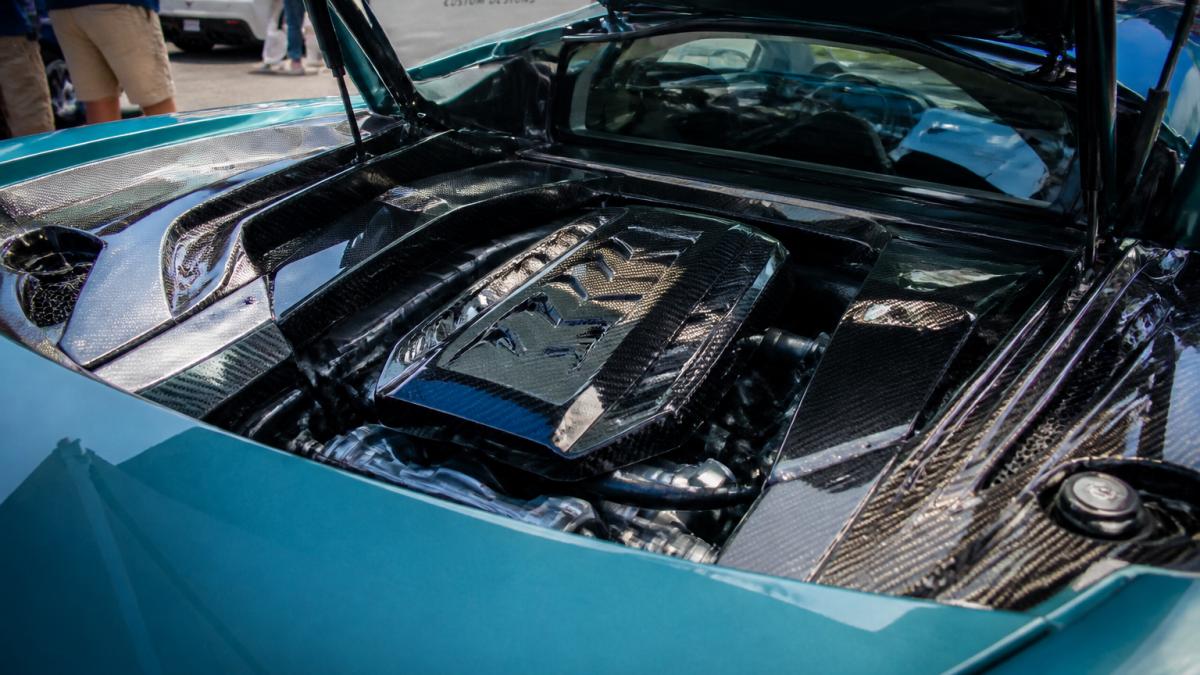
This is where the decision gets practical. A C8 engine bay rewards cosmetic upgrades more than almost any other part of the car, because everything is on display the moment the rear hatch opens.
The Misconception That Costs Buyers Money
A hydro-dipped carbon-fiber pattern does not make a part lighter, stiffer, or stronger. The base part underneath is unchanged.
That matters because some buyers assume a carbon-look part delivers carbon-fiber performance. It does not. Weight savings and structural benefit come from the material, not the finish.
What a dipped finish does deliver is appearance, protection, and customization, and in an engine bay, that is usually the entire goal.
Fitment: How These Parts Install
Our parts install over the factory components. You are adding appearance and protection without altering what is underneath. That means no cutting, no drilling into factory panels, and no permanent change to the car.
This over-the-top approach is why fitment matters more than almost anything else on a C8. Panel gaps in a Corvette engine bay are tight and visible.
Where Each Finish Shines
- Engine bay dress-up packages and engine covers: The centerpiece. A hydro-dipped carbon-fiber pattern gives the cover the look of a premium weave. Painted finishes matched to genuine GM Corvette colors suit owners who want something more personal.
- Frunk covers: High-visibility on a mid-engine car, and a natural place for a carbon-fiber pattern or a body-color match.
- Door props: Functional show pieces that get handled, so a durable clear coat matters here.
- Door sill covers: Our best sellers. They protect the factory door sills from scuffs while adding a finished look, appearance and protection in one part.
Customization: Making It Yours
Custom graphics let you make a piece unique to your car. That is the part a genuine carbon fiber panel cannot do. You can match a body color, add a graphic, or combine a carbon-fiber pattern with painted accents so the bay reads as a deliberate design rather than a parts list.
Best For
C8 owners who want a premium, personalized engine bay at car shows without paying genuine carbon fiber prices.
C8 owners who want a premium, personalized engine bay at car shows without paying genuine carbon fiber prices.
That is the honest trade. Hydro dipping gives you the carbon-fiber look and a finish you can customize. It does not give you the weight savings or structural benefit of the real material, and we will never claim otherwise.
A Quick Decision Guide
- Want structural performance or genuine weight savings? Real carbon fiber is the answer, and there is no substitute.
- Want the carbon-fiber look across an engine bay, interior trim, and show detail work? A hydro-dipped finish delivers it at a fraction of the commitment.
- Want a color-matched or graphic build that is uniquely yours? Painted and custom-graphic finishes are the fit.
- Want protection for high-wear areas like door sills? Over-the-top covers do double duty.
Most C8 owners we work with land in the second, third, or fourth category. That is exactly who these finishes are built for.
Conclusion: Which Finish Fits Your Build?
The choice comes down to what you are actually buying. If you want a structural composite with genuine weight savings, real carbon fiber is the answer and there is no substitute.
That second path is where AMT Custom Designs works every day. We build C8 Corvette accessories in-house, including engine bay dress-up packages, engine covers, frunk covers, door props, and door sill covers, finished in hydro-dipped carbon-fiber patterns or painted to match genuine GM Corvette colors.
Browse the full range at AMT Custom Designs and build an engine bay that looks like yours.
Frequently Asked Questions
What is the difference between real carbon fiber and hydro-dipped carbon-fiber-pattern parts?
Real carbon fiber is woven carbon strands set in resin, so the weave has actual depth and the part is genuinely lightweight and strong. Hydro dipped parts are base-coated, then a printed hydrographic film is floated on water and transferred onto the surface, followed by a clear coat. The result looks like carbon fiber, but the part underneath is the original material and keeps its original weight and strength. For C8 Corvette engine bay dress-up, that difference matters mostly for appearance and cost, not performance.
Does hydro-dipped carbon fiber provide the strength or weight savings of real carbon fiber?
No. Hydro dipping is a finishing process, not a structural one. The film and clear coat sit on top of the part and do not add meaningful stiffness or reduce weight. If you want the weight savings and rigidity of a genuine carbon fiber component, you need a part actually made from carbon fiber. If your goal is the carbon-fiber look across interior trim, engine covers, or door sill covers, hydro dipping delivers that appearance at a much lower cost.
How do you clean hydro-dipped automotive parts without damaging the finish?
Use a pH-neutral car wash soap, a soft microfiber cloth, and lukewarm water. Wipe gently along the pattern rather than scrubbing in circles. Avoid abrasive polishes, stiff brushes, and harsh degreasers, which can dull the clear coat. For engine bay pieces, let the surface cool first and rinse away dust before wiping.
Are hydro-dipped parts a good choice for C8 Corvette customization?
For most C8 owners chasing a show-ready engine bay, yes. Hydro dipping lets you match a carbon-fiber look or a custom graphic across engine covers, frunk covers, door props, and interior accents without paying genuine carbon fiber prices. AMT Custom Designs specializes in custom Corvette accessories with hydro-dipped carbon-fiber-pattern finishes and painted finishes matched to genuine GM Corvette colors, so you can build a cohesive look. Check the current catalog for fitment and finish options.