
7 Best Interior Accessories for Chevrolet Trucks
Table of Contents
- Why Interior Accessories Matter for Chevrolet Trucks
- How We Picked These Chevrolet Truck Interior Accessories
- 1. Custom Seat Covers and Upholstery Protection
- 2. All-Weather Floor Mats and Interior Liners
- 3. Chevy Truck Center Console Organizer
- 4. Under-Seat and Cargo Storage Solutions
- 5. Chevrolet Truck Interior Protection: Door Sills, Sill Covers, and Trim Guards
- 6. Comfort and Convenience Upgrades for Daily Driving
- 7. Chevrolet Silverado Interior Accessories: Personalization and Style
- Frequently Asked Questions
Last Updated: October 19, 2026
Why Interior Accessories Matter for Chevrolet Trucks
The cabin takes more abuse than any other part of the vehicle. Muddy boots, coffee cups, work gloves, and road trip snacks all land in the same small space, and factory trim was never built to absorb that punishment. At AMT Custom Designs, we build custom interior parts for Chevrolet vehicles, so we see which upgrades hold up and which look tired after a season.
Interior accessories do two jobs: they protect expensive-to-replace surfaces and let you shape the cabin around how you use the truck.
That second job matters more than most owners expect: a work truck and a weekend cruiser need very different interiors.
Below, we break down categories worth your attention, how to judge fitment, and where to spend versus where to save.
How We Picked These Chevrolet Truck Interior Accessories
We ranked each category on fitment accuracy by model year, trim, and cab configuration, material durability, installation effort, and long-term cleaning. Fitment came first because it is where most aftermarket purchases go wrong, a part listed for “Silverado 1500” may only fit specific cab and trim combinations.
We also weighted value over sticker price. A cheaper liner that curls at the edges costs more over five years than one that stays put. And we favored products that go on over the factory surface rather than requiring you to remove or cut original parts, which keeps resale value intact.
Pro Tip
Before ordering anything, photograph your door jamb sticker and your console layout. Model year, trim level, and cab configuration decide fitment more than the badge on the tailgate, and having those details ready prevents most return headaches.
Before ordering anything, photograph your door jamb sticker and your console layout. Model year, trim level, and cab configuration decide fitment more than the badge on the tailgate, and having those details ready prevents most return headaches.
| Accessory | Primary Job | Best For | Install Effort |
|---|---|---|---|
| Custom seat covers | Upholstery protection | Work trucks, families | Moderate |
| All-weather floor liners | Floor protection | Daily drivers | Low |
| Center console organizer | Cabin organization | Everyone | Low |
| Under-seat storage | Cargo organization | Crew cabs, gear haulers | Low |
| Door sill covers and trim guards | Entry-point protection | High-mileage trucks | Low |
| Comfort upgrades | Long-drive comfort | Road-trippers | Varies |
1. Custom Seat Covers and Upholstery Protection
Custom seat covers are a valuable interior upgrade for many Chevrolet truck owners. Factory cloth stains permanently, and leather cracks when it dries out. A fitted cover takes the wear instead.
The word “custom” matters. Universal covers slide, bunch at the bolsters, and block seat-mounted airbags if they fit poorly. Look for covers cut for your specific cab and seat configuration, including split-bench and bucket layouts.
- Material: Neoprene handles spills and mud; leatherette cleans easily and looks closer to factory.
- Fitment: Confirm coverage for your trim and whether the cover accommodates side airbags.
- Access: Check that covers leave the seat controls and folding mechanisms usable.
Watch Out
A loose cover that crosses a side airbag seam can interfere with deployment. Confirm the manufacturer states airbag compatibility for your model year before you buy.
A loose cover that crosses a side airbag seam can interfere with deployment. Confirm the manufacturer states airbag compatibility for your model year before you buy.
2. All-Weather Floor Mats and Interior Liners
All-weather floor mats are molded trays that replace or sit over factory carpet mats to contain water, mud, and road salt.
Coverage is the deciding factor: full-coverage liners run up the footwell walls and under the pedals, while basic mats leave the carpet edges exposed. Where winter road treatment is common, the full liner pays for itself in one season.
- Confirm the liner is cut for your cab and floor configuration
- Check for retention hooks that match factory anchor points
- Verify the driver-side liner clears the pedals fully
- Look for raised lips on all four sides, not just two
3. Chevy Truck Center Console Organizer
A Chevy truck center console organizer divides the deep factory console into usable trays so small items stop disappearing into the bottom. Most trucks have generous console volume and almost no structure inside it.
Drop-in organizers add a top tray with dividers for pens, cables, and sunglasses, plus side pockets that use otherwise dead space. The best ones are vehicle-specific, following the console contours instead of rattling around.
Best For
Owners who treat the console as a catch-all and are tired of digging for keys, charging cables, or registration at the toll booth.
Owners who treat the console as a catch-all and are tired of digging for keys, charging cables, or registration at the toll booth.
Skip anything that blocks the console lid from latching or covers the USB ports. Measure the opening before ordering.
4. Under-Seat and Cargo Storage Solutions
Under-seat storage turns the empty space beneath the rear bench into a divided or lockable compartment for tools, straps, and emergency gear. On crew cabs that space is substantial and almost always wasted; on double cab and regular cab models it is shallower or absent, so check fitment before ordering.
Storage accessories for Chevrolet trucks fall into four groups, and each solves a different problem:
- Under-seat boxes: Rigid trays or lockable drawers that sit in the well beneath the rear bench. Best for tow straps, jumper cables, gloves, and tools that would otherwise slide under the seat. Confirm the box clears the seat folding mechanism and any factory jack or subwoofer mounted in that well.
- Seat-back organizers: Strapped panels that hang from the front seat backs. Good for maps, gloves, small tools, and kids’ items within reach of the front row. Look for ones that leave the seat-back map pocket usable and do not interfere with the seat folding forward.
- Console and underseat dividers: Drop-in trays that split a large open well into smaller compartments so items stop migrating. These are the lowest-effort option and the easiest to remove if you trade the truck in.
- Bed cargo organizers: Bars, dividers, and cargo blocks that keep groceries and equipment from shifting on the drive home. These are technically outside the cabin, but they belong in the same conversation because they solve the same problem: giving every item a fixed home.
Two fitment details decide whether an under-seat box works. First, cab configuration: a crew cab rear bench sits over a deeper well than a double cab, and a regular cab has no rear bench at all. Second, factory content: trucks with a rear seat entertainment screen, subwoofer, or power inverter in the under-seat area need a box designed around that hardware. Measure the well depth and width, and check whether the lid opens without hitting the folded seat.
The safety case matters as much as the tidiness case: loose tools and straps become projectiles in a hard stop, and a divided compartment keeps them contained.
Pro Tip
Empty the under-seat well and measure it with a tape before you shop. Note the depth at the front and back of the well, the width between the seat brackets, and whether the jack or subwoofer sits in the middle. Those three numbers rule out most wrong-fit purchases.
Empty the under-seat well and measure it with a tape before you shop. Note the depth at the front and back of the well, the width between the seat brackets, and whether the jack or subwoofer sits in the middle. Those three numbers rule out most wrong-fit purchases.
Owners who get this right start with one under-seat box sized to the most-used gear, then add a seat-back organizer for items that need to stay within reach.
5. Chevrolet Truck Interior Protection: Door Sills, Sill Covers, and Trim Guards
Chevrolet truck interior protection starts at the entry point. Door sills take a beating from boots, gravel, and repeated scuffs, and once the factory finish wears through, it is expensive to correct.
Door sill covers are a popular part. They go on over the factory sill, shield the original surface, and add a finished look that holds up to daily entry and exit. Because they install on top of what is already there, there is no cutting or removal, and the factory finish stays intact underneath.
Trim guards extend the same logic to high-traffic edges: door kick panels, threshold strips, and cargo openings. Custom graphics let you make these parts your own.
These are the parts owners notice at car shows, because they sit right where the door opens and the light hits.
6. Comfort and Convenience Upgrades for Daily Driving
Comfort upgrades tailor the cabin to your driving; the right picks depend on whether you commute, tow, or take long highway trips.
- Sunshades: Cut heat buildup on parked trucks and protect the dash from cracking.
- Seat cushions and lumbar support: Worth it for long drives, especially in work trucks with firm seats.
- Steering wheel covers: Improve grip and protect the factory wheel from wear.
- Cargo lighting: Makes the bed and footwells usable after dark.
None are glamorous, but all change how the truck feels on a two-hour drive.
7. Chevrolet Silverado Interior Accessories: Personalization and Style
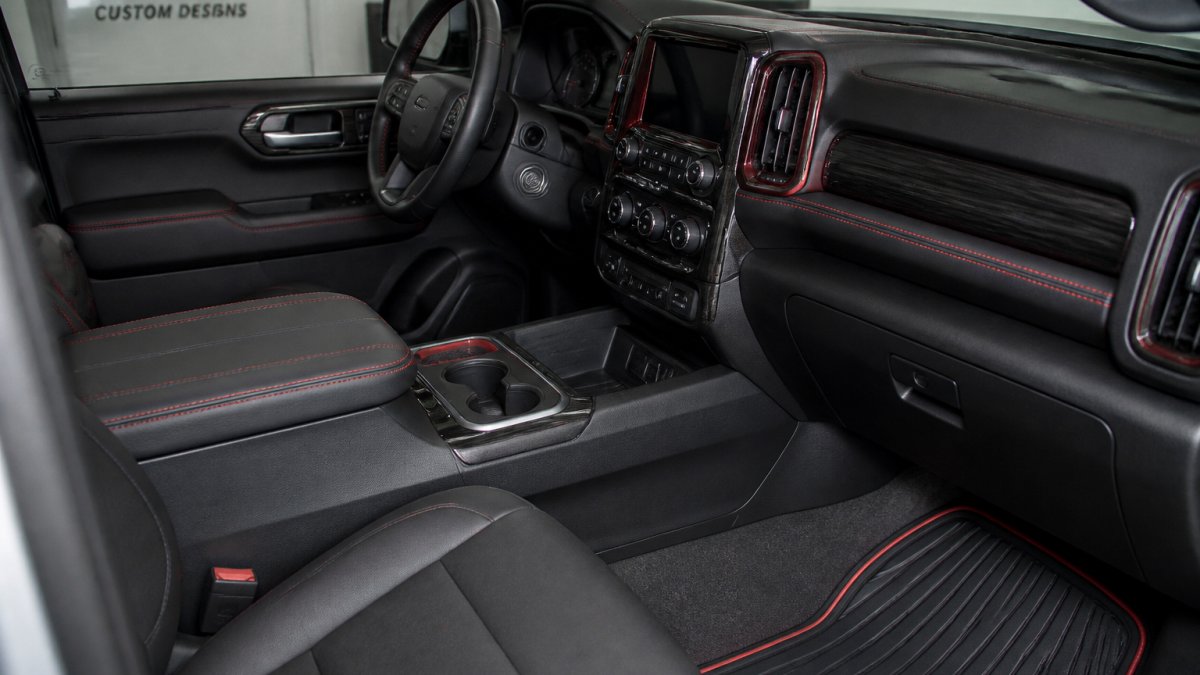
Chevrolet interior accessories do more than protect, they signal that the truck is yours. Painted and custom-finished trim pieces, accent panels, and personalized graphics turn a factory cabin into something you recognize instantly.
Owners tend to hold back here, and it is usually a mistake: small accent pieces cost far less than a full interior redo and deliver most of the visual payoff. Start with the parts you see every time you open the door, sills, console trim, and dash accents, since those surfaces carry most of the first impression and take the most wear.
The fitment question competitors skip is trim-level variation. A Silverado WT, LT, RST, LTZ, and High Country do not share the same interior trim panels, and the same is true across the 1500, 2500HD, and 3500HD lines. A dash accent cut for an LT may not sit flush on a High Country with a different dash finish, and a console trim piece for a bench-seat truck will not fit a bucket-seat console. Before ordering, confirm the seller lists your trim level and cab configuration, not just the model name. Photograph the panel you intend to accent and send it with your order when a seller offers that option; it prevents the most common return reason in this category.
Finish durability is the second question worth asking. Custom graphics and painted accents live in a cabin that sees sun, heat cycling, and repeated cleaning. Ask how the finish is applied and how it holds up to UV exposure and mild cleaners, a finish that fades in a year is worse than no upgrade at all.
Key Takeaway
Personalization is a fitment problem before it is a style problem. Match the part to your trim level and cab configuration first, then choose the finish. That order prevents the two failure modes owners complain about most: a part that does not sit flush, and a finish that fades.
Personalization is a fitment problem before it is a style problem. Match the part to your trim level and cab configuration first, then choose the finish. That order prevents the two failure modes owners complain about most: a part that does not sit flush, and a finish that fades.
For owners who take the truck to car shows, accents at the entry point and the console can make a significant impact, where judges and spectators look first when a door opens. Coordinate two or three pieces in a matching finish rather than scattering one-off accents, and the result looks factory-adjacent rather than added-on.
When you order custom-finished parts, ask for a sample or a photo of the same finish on a completed truck, that tells you more about how the part will look installed than any product description.
Frequently Asked Questions
What are the most useful interior accessories for a Chevrolet truck?
Seat covers, all-weather floor liners, a center console organizer, and under-seat storage top most owners’ lists because they protect the cabin and cut daily clutter. Door sill covers and trim guards add another layer of protection where boots and cargo scuff the finish. Personalization pieces like custom interior accents round out a build for car shows. Start with protection, then add organization, then style.
How can I protect the interior of my Chevrolet truck?
Layer protection from the floor up. All-weather liners catch mud and spills, seat covers shield upholstery from work clothes and pets, and door sill covers guard the painted or brushed thresholds where boots land. Cargo-area mats and organizers keep tools from sliding. Wipe liners and covers with mild soap and water, and check fitment by model year and cab configuration before ordering.
Are Chevrolet truck accessories compatible across model years?
Not always. Cab configuration, trim level, and model year change mounting points, console shape, and floor contours, so a part that fits a 2019 Silverado 1500 may not fit a 2026. Shop by vehicle using the year, trim, and cab, and confirm the listing names your exact configuration. When in doubt, ask the seller for fitment confirmation before you buy.
Are factory accessories or aftermarket accessories better for a Chevrolet truck?
Factory accessories guarantee fitment for your specific truck and keep the warranty path simple. Aftermarket options often offer more finishes, custom graphics, and personalization that factory catalogs do not carry. Many owners mix both: factory floor liners for everyday duty and aftermarket trim or console pieces for style. Compare materials, installation method, and return policy before deciding.